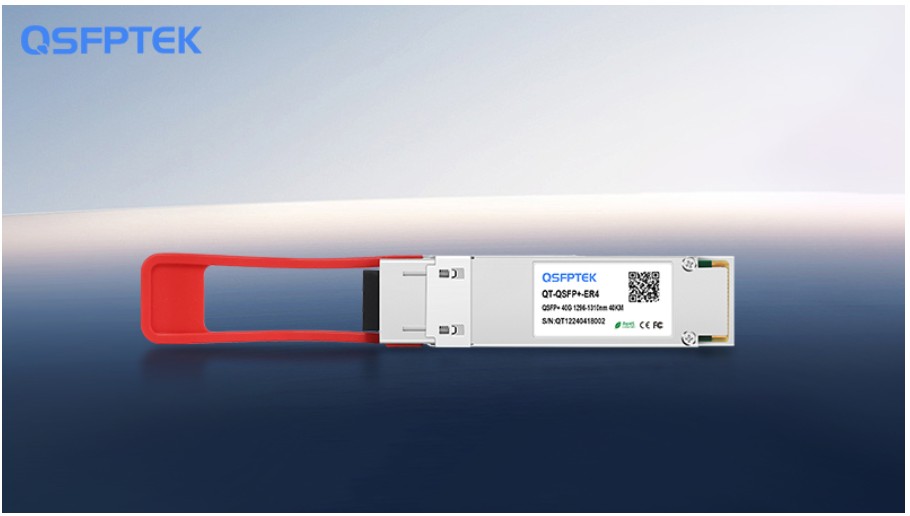

Although 100G and even higher-speed Ethernet technologies have become increasingly common, 40G networks remain widely deployed in many metro and backbone environments. For long-distance links in particular, network operators often prioritize stability, reach, and cost control over adopting the latest interface speeds. In this context, the QSFP+ 40GBASE-ER4 optical module continues to play an important role. Designed for 40 km transmission over single-mode fiber at a 1310 nm wavelength, 40GBASE-ER4 QSFP+ modules offer a proven and reliable solution for long-reach 40G Ethernet deployments. Their continued use reflects not technological stagnation, but rather the practical realities of existing network architectures and operational requirements.
Overview of QSFP+ 40GBASE-ER4 Optical Modules
QSFP+ 40GBASE-ER4 is a long-reach 40G Ethernet transceiver that uses coarse wavelength division multiplexing to transmit four 10 Gbps channels over a single pair of single-mode fibers. Operating in the 1310 nm window, these four wavelengths are multiplexed at the transmitter and demultiplexed at the receiver, enabling a total data rate of 40 Gbps. With a maximum reach of up to 40 km, ER4 modules are specifically designed for scenarios where standard LR4 or short-reach solutions are insufficient.
The QSFP+ form factor allows for relatively high port density on switches and routers while maintaining compatibility with established 40G network equipment. Compared with newer form factors introduced for higher-speed interfaces, QSFP+ remains widely supported across legacy and current-generation platforms. This broad compatibility is one of the key reasons why 40GBASE-ER4 modules are still deployed in operational networks today.
The Ongoing Need for Long-Reach 40G Connectivity
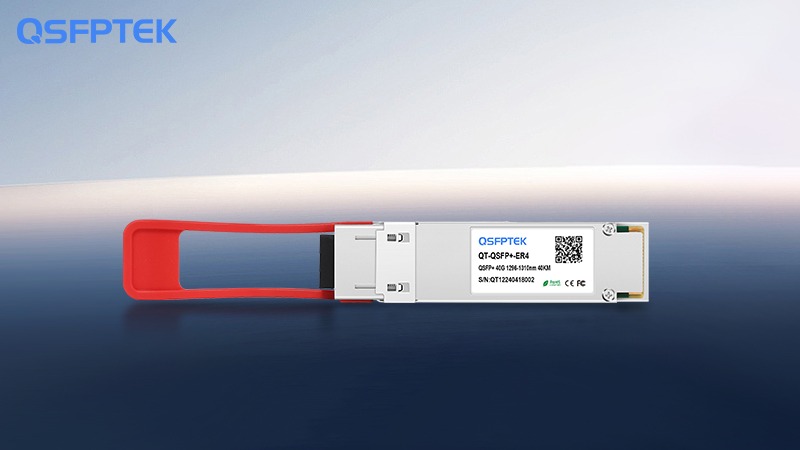
Many long-reach network links were designed and built during a period when 40G Ethernet represented the optimal balance between bandwidth and cost. Metro networks, regional backbones, and inter-building enterprise links often span distances well beyond 10 km, making short-reach and mid-reach optical modules unsuitable. While 100G ER4 and similar technologies are available, upgrading to higher speeds is not always justified from a technical or financial standpoint.
In environments where traffic demand remains stable and does not exceed 40G capacity, replacing existing links with 100G solutions may offer limited tangible benefits. The optical infrastructure, routing policies, and network design are already optimized around 40G. In such cases, QSFP+ 40GBASE-ER4 modules allow operators to maintain long-distance connectivity without introducing unnecessary complexity or triggering large-scale network upgrades.
Stability and Maturity of ER4 Technology
One of the most compelling reasons for the continued use of QSFP+ 40GBASE-ER4 is the maturity of the technology. ER4 modules have been deployed for many years in carrier-grade and enterprise networks, and their performance characteristics are well understood. This maturity translates into predictable behavior, stable interoperability, and well-established operational best practices.
In long-reach deployments, reliability is often more critical than raw speed. ER4 modules are designed to deliver consistent optical performance over extended distances, even in challenging environments. Their use of standardized CWDM wavelengths and single-mode fiber ensures compatibility with existing optical infrastructure, including patch panels, fiber routes, and monitoring systems. For network operators, this reliability reduces operational risk and simplifies long-term maintenance.
Cost and Upgrade Considerations in Existing Networks
Upgrading long-reach 40G links to 100G or higher speeds often involves more than simply replacing optical modules. Higher-speed interfaces may require new line cards, updated switching platforms, and, in some cases, changes to the optical design to accommodate different power budgets or dispersion characteristics. These upgrades can be costly and disruptive, especially in live networks that support critical services.
QSFP+ 40GBASE-ER4 modules provide a cost-effective alternative by extending the life of existing 40G infrastructure. For organizations with large installed bases of 40G equipment, continuing to deploy ER4 modules allows for incremental expansion or replacement without forcing a comprehensive network redesign. This approach is particularly attractive in metro and enterprise backbone networks, where budgets are closely managed and network stability is a top priority.
Applications in Metro and Backbone Networks
In metro networks, QSFP+ 40GBASE-ER4 modules are commonly used to connect aggregation nodes, data centers, and core network elements across distances that exceed the reach of LR4 modules. The 40 km transmission capability enables flexible network topologies while minimizing the need for intermediate regeneration sites. This helps reduce operational complexity and improves overall network efficiency.
Similarly, in backbone and large enterprise networks, ER4 modules support long-distance links between campuses, buildings, or regional hubs. These deployments often rely on existing single-mode fiber routes that were designed for long-haul transmission. By leveraging ER4 optics, network operators can fully utilize these fiber assets while maintaining consistent performance across the backbone.
Relevance of ER4 in a Multi-Speed Network Environment
Modern networks rarely operate at a single interface speed. Instead, they consist of a mix of 10G, 40G, and 100G links, each serving different roles within the overall architecture. In this multi-speed environment, QSFP+ 40GBASE-ER4 modules continue to provide a valuable option for specific long-reach use cases where higher speeds are unnecessary or impractical.
Rather than being replaced outright by newer technologies, ER4 modules coexist with higher-speed optics, allowing networks to evolve gradually. This layered approach to network evolution helps organizations align technical capabilities with actual business and traffic requirements, avoiding premature or excessive investment.
Conclusion
QSFP+ 40GBASE-ER4 optical modules remain an important component of long-reach 40G Ethernet deployments due to their proven reliability, extended transmission distance, and strong compatibility with existing network infrastructure. While higher-speed technologies continue to advance, many metro and backbone networks still rely on stable, well-understood 40G links to support critical services. By offering up to 40 km reach over single-mode fiber at 1310 nm, 40GBASE-ER4 QSFP+ modules provide a practical and cost-effective solution for maintaining long-distance connectivity in today’s heterogeneous network environments.

