

Financial modeling often feels like the “final boss” of a finance degree. One day you are learning basic accounting ratios, and the next, you are staring at a blank Excel sheet, expected to project a company’s five-year future based on nothing but historical data and market intuition. It is a transition that leaves many undergraduates feeling overwhelmed. However, mastering this skill isn’t just about being a “math whiz”; it’s about understanding the story that numbers tell about a business’s health and potential.
The primary hurdle for most students is the sheer complexity of integrating three-way financial statements. When your Balance Sheet doesn’t balance, or your Cash Flow Statement shows a random discrepancy, it can lead to hours of frustration. This is precisely why many students look for external resources to bridge the knowledge gap. Seeking help with finance homework has become a standard strategy for those who want to see a “best practice” model before they attempt to build their own from scratch. Seeing a correctly structured model provides a blueprint that textbooks often fail to explain clearly, allowing you to reverse-engineer the logic and apply it to your own future projects.
Why Financial Modeling Matters in the Real World
In the professional world, a financial model is a decision-making tool. Whether a company is looking to acquire a competitor, launch a new product, or raise capital, they rely on these models to predict outcomes. For an undergraduate, learning this now is the ultimate resume booster. It shows recruiters that you can take theoretical knowledge—which is often static and academic—and apply it to a functional, dynamic environment where variables change in real-time.
When you sit down for an interview at an investment bank or a corporate finance firm, they won’t just ask if you know what “WACC” stands for. They will likely give you a laptop and ask you to build a basic discounted cash flow (DCF) model. If you have spent your university years mastering the art of the spreadsheet, you are already miles ahead of the competition.
The Core Components of a Robust Model
To build a model that actually works and stands up to scrutiny, you need to follow a strict logical flow. Most professional models are broken down into three distinct areas to keep things organized:
- Assumptions and Inputs: This is the “brain” of your model. All hard-coded numbers—like historical revenue growth, tax rates, or interest percentages—go here. By keeping them in one place, you can change one number and see the entire model update instantly.
- Calculations: This is the engine room. This is where you use formulas to link your assumptions to the financial statements. This includes building out your depreciation schedules, debt tables, and working capital requirements.
- Outputs: These are the results. It usually includes the finished Three-Statement Model, charts, and summary tables that executives or professors actually look at to make a final judgment.
Navigating the “Circular Reference” Trap
One of the most complex parts of modeling is dealing with interest expense and average debt. Because interest depends on debt levels, and debt levels can be affected by the cash remaining after interest, Excel can get confused. This is known as a circular reference. Cracking this code requires a deep understanding of Excel’s “Iterative Calculation” settings or, more importantly, the underlying financial logic that prevents the model from crashing.
When the logic gets too circular and the deadline is looming, the pressure can be immense. It’s during these high-stakes moments that many students decide to reach out to professionals at Myassignmenthelp and ask them to pay someone to do my homework to ensure the technical integrity of their files. Having an expert look over your logic ensures that your debt schedules and interest hooks are functioning correctly before you submit a project that represents a large portion of your grade. This kind of professional review acts as a safety net, teaching you how to structure complex formulas without the risk of failing an assignment.
Essential Financial Modeling Ratios
To make your model truly professional, you must include a ratio analysis section. This interprets the raw data into something meaningful for stakeholders.
| Ratio Category | Key Formula | Why It Matters for Students |
| Liquidity | Current Assets / Current Liabilities | Shows if the company can pay short-term debts. |
| Profitability | Net Income / Revenue | Measures how much profit is generated from every dollar of sales. |
| Leverage | Total Debt / Equity | Indicates the degree of financial risk the company is taking on. |
| Efficiency | Revenue / Total Assets | Shows how well the firm uses its assets to generate sales. |
Best Practices for Clean, “Human” Modeling
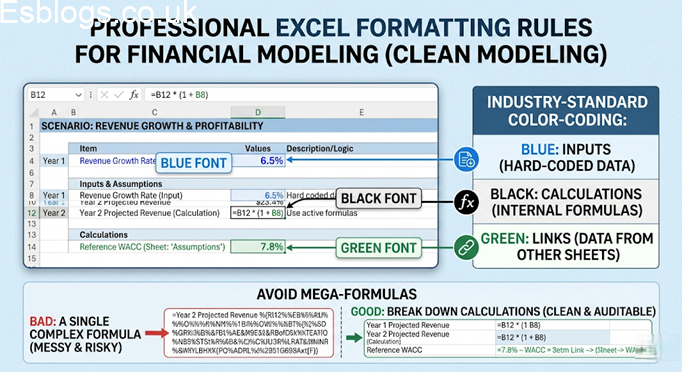
If you want your model to be readable and professional, you must move away from the cluttered sheets often seen in beginner projects. Follow these industry-standard formatting rules:
- Consistent Color Coding: This is the universal language of finance. Use Blue for hard-coded inputs, Black for formulas that stay on the same sheet, and Green for links that pull data from other sheets. This makes it easy for anyone else to audit your work.
- Avoid “Mega-Formulas”: If a calculation is too long to read in the formula bar, it is likely too complex. Break it into two or three smaller, digestible steps in “helper” rows. This makes debugging much easier when something inevitably goes wrong.
- Build for the User: Always include a “Cover” sheet or a “Table of Contents.” Explain what the model does, define the units (e.g., “Millions of USD”), and list the date of the last update. A model that no one else can understand is a useless model.
The Importance of Sensitivity Analysis
A great financial model isn’t just a single prediction; it’s a range of possibilities. This is where “Sensitivity Analysis” comes in. By using Data Tables in Excel, you can show how a change in revenue growth or a shift in the discount rate affects the final valuation of a company. For an undergraduate, including a sensitivity matrix in your assignment shows a level of sophistication that usually earns the highest marks. It demonstrates that you understand that the future is uncertain and that a good analyst accounts for multiple scenarios.
Transitioning from Theory to Practice
The jump from “classroom finance” to “Excel finance” is steep. Undergraduates often focus too much on the math and not enough on the business logic. Before you type a single number, ask yourself: Does this growth rate make sense for this industry? If you are modeling a mature utility company, a 20% annual growth rate is unrealistic. Your model is only as good as the assumptions you feed into it—a concept often referred to as “Garbage In, Garbage Out.”
By treating financial modeling as a craft rather than a chore, you develop an analytical mindset that stays with you throughout your career. It’s about more than just passing a class; it’s about gaining the ability to look at any business in the world and understand exactly how it makes money.
Frequently Asked Questions (FAQ)
1. What is the most important skill for financial modeling?
Ans: While Excel proficiency is vital, a solid understanding of accounting is the true foundation. You cannot build a model if you don’t understand how a change in accounts receivable impacts your cash position.
2. How can I practice modeling for free?
Ans: You can download annual reports (10-K filings) from public companies and try to recreate their last three years of financials in Excel. Compare your results to their reported numbers to check your accuracy and see where your logic differs from reality.
3. Why do my financial models always break?
Ans: Most models break because of “hard-coding” numbers inside formulas. For example, instead of typing *0.25 for a tax rate inside a formula, you should link to a cell that contains the value 25%. This ensures that when the tax rate changes, the whole model updates automatically.
4. Is financial modeling used in all finance jobs?
Ans: Almost all of them. From Investment Banking and Equity Research to Corporate Development and Private Equity, the ability to build, interpret, and defend a model is a core requirement for any high-level finance role.
About The Author
I am Mark Hales, a Senior Academic Consultant at Myassignmenthelp with over a decade of experience in financial analysis and educational strategy. My professional journey began in corporate finance, where I specialized in building dynamic forecasting models for multinational firms.

